
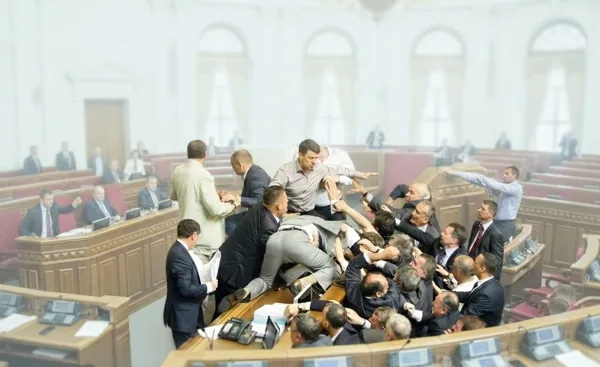
You’ve probably seen pictures more than once of politicians physically brawling with each other. This picture was taken in the Ukrainian parliament in December 2012 (The Guardian, 2012). As voters, we instinctively know that when politicians end up in a wrestling heap, the decision-making process — and with it the country’s future — is in bad shape.
The quality of our discussions equals the quality of our decisions. When we’re good at discussing things and can have a constructive discussion, we also make better decisions.
The challenge is that, in the meeting room, we naturally hold back from discussing things if we’re unsure whether the discussion will end constructively. When we, as colleagues, have to see each other every day, we tend to value a good relationship more highly than digging deep to solve a problem. But there’s only one thing worse than unconstructive discussions, and that’s having no discussions at all.
Whether or not you sit in Ukraine’s parliament, I’d suggest you use this template for inspiration the next time a discussion is needed. You can also print it out and put it up in your meeting room.
| Tactics | Strategy |
|---|---|
| Focus on the facts When the team’s data is plentiful and up to date, discussions can more easily stay focused on the issue. Conversely, participants can easily get personal when they have no concrete starting point. I meet far too many teams that discuss things based on hunches and guesswork about what the world looks like. They have little idea how customers see them, how the rest of the organisation sees them, or what the competitors look like. It’s not enough to believe you’ve earned your place with customers just because you’re a big company — just as it doesn’t hold up to cling to the belief that you have no competitors, even if you’re, say, a public institution. |
Focus on the issue, not on the people. |
| Create 4–5 alternative solutions That way the debate is enriched. If you ask the team to come up with one or two proposed solutions, the team will either strongly agree or strongly disagree. The fewer proposed solutions the team comes up with, the more black-and-white the discussion becomes too. More alternatives also make it easier for members to change their minds without losing face, and the team’s proposals will be more innovative than if there are only a few. If you can’t get the debate going again, you can start by putting forward proposals you don’t believe in yourself. |
|
| Discuss from a goal It can be fine to discuss the route to Skagen, if that’s where everyone wants to go. But the team can waste a lot of time discussing the route to Skagen if one person would actually rather go to Tønder. Teams that get stuck in conflict often lack a clear shared goal. When the goal is clear, and the individual takes a team viewpoint rather than an individual one, you quickly start to see each other as possibilities instead of threats. |
Frame the decisions as a collaboration meant to ensure the best possible solution for the team (A. Gallo, 2010). |
| Invite humour into the decision-making process When teams have to make decisions, humour works as a release valve and a lightning rod against the stressful situations that can easily arise during a decision-making process. It helps the individual psychologically distance themselves from the situation — typically through irony. Humour can take the edge off something that’s otherwise hard to say. On top of that, humour can soften a message. That way the mood can shift from competitive to collaborative. |
|
| Make sure the balance of power is kept When you facilitate a conflict, it’s important that you find the balance between being far too controlling and far too weak. Among others, I spoke to a leader who summed up their philosophy like this: “In the decision-making process, it’s about involving as many people as possible, so you can then make fast decisions.” Often the most important thing for the team isn’t getting its own opinions through, but having a clear sense that it has had airtime and been listened to, and that its view has been drawn into the decision-making process. The most constructive conflicts I’ve experienced have been in teams where the leader and the facilitator have been team players. A strong, dogmatic style of leadership in Scandinavian teams, by contrast, brings nothing good with it. |
Create a sense of fairness and equality in the process. |
Don’t force the team to reach agreement:
When you facilitate a conflict, it’s far better to judge as quickly as possible whether the team can reach consensus or not. If not, make the call based on the team’s input — then the team will also get behind the decision. |
|
Sources and more inspiration
Ukrainian MP’s in Fist-Fight in Parliament
The Guardian, 2012
Get Your Team to Stop Fighting and Start Working
A. Gallo, 2010, Harvard Business Publishing