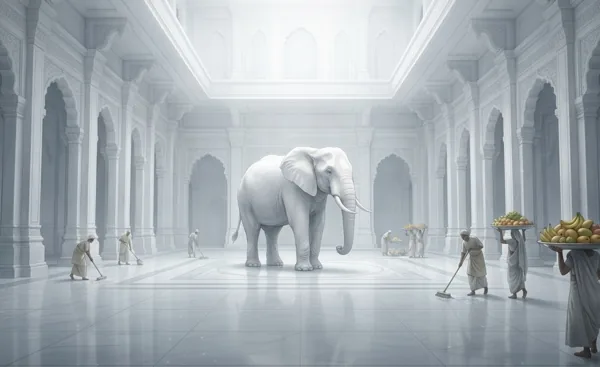
When the team has to make decisions, its success doesn’t necessarily depend on whether it makes good ones and bad ones, but on whether it corrects its course. If it doesn’t, the team can risk creating a so-called white elephant. Read here about what that is, and what you can do so you don’t end up in the same situation as some of these teams.
The expression “a white elephant” comes from East Asia, where, in Burma, albino elephants are considered sacred. They are very fragile, can’t work and have to be cared for with the utmost attention. If you were to give someone a white elephant, you’d give it to your worst enemy, because caring for it would devour an entire fortune.
One example of a white elephant is London’s Millennium Dome, which the British government built to celebrate the turn of the millennium — but ever since it has been, and still is, a giant loss-making venture. Another example is the Olympic stadium built in Montreal for the 1976 Summer Olympics. It cost 2.3 billion dollars to build and today stands empty for most of the year. In North Korea, work began on the Ryugyong Hotel as a counterpart to great Western monuments like the Sears Tower. The hotel today stands as an empty concrete shell and will probably never be finished. The project cost 2 % of North Korea’s GDP. Concorde is a well-known example of a white elephant. Only 14 aircraft ever saw the light of day, even though development costs were equivalent to more than a hundred planes. Concorde never became a financial success and flew for the last time in 2005. Critics of the American space shuttle would also argue that it’s one of the US’s great white elephants compared with other forms of spaceflight.
Some projects start out as white elephants but end up changing colour anyway. The World Trade Center was quickly given the nicknames Nelson and David, after the two Rockefeller brothers who stubbornly insisted on the project despite Manhattan’s falling house prices in the mid-1970s. London has also had its white elephant in the shape of the Docklands — a giant building project that peaked with the market saturation of the 1980s. The buildings stood empty and were a great gift to British satire, but today it has become a financial centre.
Here’s how to keep your project from ending up as a white elephant:
1) Face the grim truths. We often use euphemisms to soften things: “I was a little late” — no, you were late. “I probably smoke a bit too much,” — no, you smoke… too much. A euphemism wraps things up, lays a smokescreen over the problems and gives us no incentive to act. So face the grim truths, even if there’s pain involved.
2) See the new future you want to create — and it has to be positive. Once you’ve recognised that you’re building a white elephant, you have to see a different, new future that gives you energy. There’s no use being pessimistic here, which typically comes from a fear of being hurt. It does, on the other hand, take courage. So find the courage to do what you really want — instead of looking for the motivation in something you basically can’t be bothered with. That way, energy is no longer something you have to look for — but something you have to try to steer.
3) Build yourself a new future. Once you’ve seen the world you want to create, you have to do it. Surround yourself with people who give you energy. Some people make us shine, while in others’ company we don’t shine at all. So spend less time with people who drag you down, and more time with the ones who lift you up.
Enjoy!
/Martin