
If your company still looks like the classic org chart, you’re probably trying to solve a problem that no longer exists. That’s because many organisations are optimised to be efficient. That’s how the world was when they were born, and that’s how many organisations still look today. The challenge is that efficiency is no longer the top priority. Efficiency has become the second priority. Adaptability is the most important thing today, because complexity is rising sharply. That’s why teams are today the fastest-growing form of organisation – because they can adapt quickly when paper meets reality. The reason for this shift is clear when you compare an organisation 100 years ago with the Iraq War in 2004. Here the American military faced a kind of enemy it had never met before. On paper, the Americans were superior – but in reality they were losing the war.
In 1911, the American engineer Frederick Taylor published his book The Principles of Scientific Management (Taylor, 2006). It became the start of an international revolution and made Frederick Taylor the Steve Jobs of his day. The ideas grew out of Taylor’s experience and experiments from his work at the Midvale Steel steelworks in Pennsylvania. In the book, Taylor described how an industrial company could increase its efficiency by drawing up detailed instructions for each individual sub-task. He believed work should be divided so that the manager was the one who devised methods and processes, and the worker the one who physically carried out the work. Taylor thereby developed a so-called “best practice” based on the philosophy that there is always one best way to do the work.
It can sound obvious today, but back then it was a revolutionary way of thinking. In those days, an apprentice spent five to seven years learning from a master. There was no systematic approach and no study of the work. Nothing was written down, and there were no plans or working drawings of the work to be done. Taylor’s ideas took work in the steel industry from being an art form to a science, where the work could be reduced to a formula, learned by anyone and repeated with the same result. The complicated tasks were simplified into small sub-tasks, where each sub-task was given a recipe the worker had to follow (Drucker, 1993). It meant industry could now train its workers far faster, pay them less and so increase the profit. Taylor’s ideas inspired everyone from Henry Ford to Lenin in Russia (Scoville, 2001).
Taylor shaped the org charts, so the balance of power shifted. At the top sat management with all the knowledge of how methods and processes should be designed. At the bottom of the organisation, the workers acted as management’s extended arms and legs. As long as the workers followed the recipe, efficiency was assured. Efficiency was the top priority, and it stayed that way for many decades to come. But over the past 20 years, there’s been a paradigm shift in this priority. Efficiency is still important, but it’s no longer an organisation’s undisputed top priority.
Taylor believed work should be divided so that the manager was the one who devised methods and processes, and the worker the one who physically carried out the work.
Let me illustrate with Stanley McChrystal’s experience from his time leading the American Special Operations Task Force during the Iraq War (McChrystal, 2015).
A hot afternoon in Baghdad
It was Thursday afternoon, 30 September 2004. In a market square in one of Baghdad’s poor neighbourhoods, American soldiers were handing out sweets to children. An old Hyundai, packed with gas canisters, swung into the square. Shortly after, the driver set off a huge explosion that instantly created chaos. There were many children among the victims, and mothers and soldiers came running. Everyone was so busy with the rescue work that they didn’t notice another car swinging into the market square. It exploded too, making the disaster complete. The dust had barely settled before a third car exploded. Among the many victims were 35 children, and the operation was so successful for Al Qaeda that a fourth car turned back. The event made headlines around the world (Filkins, 2004), and for the American force it was an eye-opener.
The paradox was that the American force was large, well trained, used the most advanced weapons and could deploy soldiers anywhere in the world with a precision measured in minutes. Internally, it called its counter-terrorism unit “an awesome machine”. Here it faced an enemy that was less well trained, had worse weapons, worse communications technology and nothing like the same high discipline as the Americans. On paper, Al Qaeda was not a worthy rival to the American force, yet the number of these kinds of attacks kept rising. Why was the American “machine” losing the fight against an enemy that, bluntly put, was wearing sandals?
The answer was that the Americans focused on increasing their efficiency, but they faced an enemy that focused on being adaptable. Al Qaeda were skilled at constantly adapting to the circumstances with the few resources they had. That was enough to bring the super-efficient machine to its knees. Where the American force worked from a classic org chart with knowledge at the top and arms and legs at the bottom, Al Qaeda operated in cells and networks.
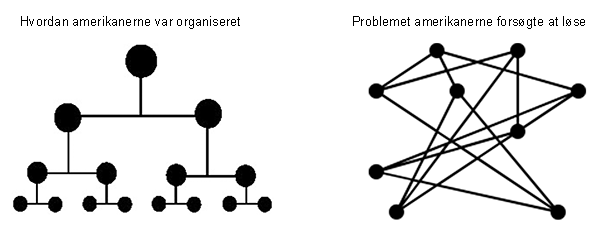
Source: McChrystal, 2015
Complicated vs. complex
The American force’s situation in Iraq can be compared to the challenges many organisations face today. They were born into a world where the tasks were complicated but predictable. So it was important to be able to set out a plan and see it through as efficiently as possible. The challenge today is that complexity is rising. The situations organisations find themselves in are becoming ever harder to predict, which is why there’s a need to reorganise so that flexibility and adaptability take top priority (Nason, 2017).
The difference between complicated and complex is significant. A car’s engine is complicated. Even though it’s made up of many components, each individual component affects the others in a simple way. Like two cogs meshing together, it’s relatively easy to predict how the engine reacts if we remove a component.
A complex situation, by contrast, is impossible to predict. Where do the balls land on a pool table after the break? We don’t know exactly. Even though, with eight balls, there are relatively few components, we can’t recreate the same result twice. The result of each break will be different, because every component affects the others in many different ways.
Al Qaeda were skilled at constantly adapting to the circumstances with the few resources they had. That was enough to bring the super-efficient machine to its knees.
When the American force grasped this difference, they also realised they’d been looking for an enemy organised like themselves – because that way they could understand the enemy and defeat it. But Al Qaeda were organised completely differently, and so it became clear the Americans had to reorganise. As an army, the Americans could probably defeat any other army, but now they faced a network, and so they too had to build a network of teams. It became a break with almost every previous way of working.
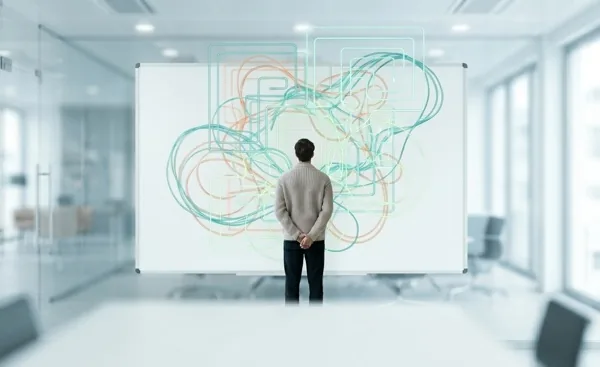
For example, they realised it was impossible to predict which information would be relevant to whom and when. So they created transparency by making all information available to everyone. It was a major break with the old “on a need-to-know basis”. Another break with the culture was that knowledge and decision-making were now decentralised. Before, in true Taylor style, the decisions came from the top. Now far greater freedom was given to the individual teams to make their own decisions. The new reality also meant that maps suddenly became secondary. For a military, maps are an essential part of the work. Strategy is laid out from them, and the course of the battle is followed closely as the lines between the sides move. Instead, they used whiteboards to draw the enemy’s network and relationships (McChrystal, 2015).
The American organisation had been designed to solve a problem that no longer existed. Now it faced a kind of enemy it had never met before. Slowly but surely, the organisation began to look like the new reality.
As an army, the Americans could probably defeat any other army, but now they faced a network – and so they too had to build a network of teams.
The demands on the team rise with complexity
Since the turn of the millennium, complexity has risen across industries. One example is the pharma industry. New technologies have created a biomolecular revolution, which has created a market for targeted medicine, which in turn has significantly increased the complexity of research and development (Jones, 2009). It has increased the number of specialists and means that development today takes much longer and is more expensive. A patent typically runs for 20 years from when the application is filed. That means the more years the pharma company has to spend on product development, the less time it has to earn the money back once the product reaches the market. Complexity means the demands on the team’s performance are significantly higher. That goes both for the teams that develop the product and for those who later have to market and sell it.
The picture is relevant not only for the pharma industry but for every organisation where complexity is rising. Today, a team’s members have to be able to coordinate their effort so everyone pulls together. They have to be able to take on each other’s tasks to avoid bottlenecks. If the team isn’t working well, it has to be able to diagnose why and solve the problem. The members have to be able to set goals and resolve conflicts between them, so their relationships are strengthened – and finally, the team has to be good at communicating, leading and making decisions (Salas, 2017). For many team members, including those in the pharma industry, all of this has to happen across time zones, geography and cultures, and in several teams at once. Very few people work in just one team at a time. Research shows that 65–95% of employees work in more than one team at a time (Mortensen, 2007).
The American organisation had been designed to solve a problem that no longer existed.
The demands are high, and there are a lot of balls in the air. When the tasks go from being complicated to complex, it’s nowhere near enough to make a plan that looks good on paper. You need a real team that can stand together when reality hits. Yet many organisations still look the way they did “in the old days”, perhaps because change is hard.
So what do you do when paper meets reality? Do you come together in teams, or are you still trying to solve the problem with Taylor’s system?
Sources
Teamorganisering. Veien til mer fleksible organisasjoner
Assmann, 2008, Fagbokforlaget
The Principles of Scientific Management
Taylor, 2006, Cosimo Classics
The Rise of the Knowledge Society
Drucker, 1993, Wilson Quarterly
The Taylorization of Vladimir Ilich Lenin
JG Scoville, 2001, Industrial Relations
Team of Teams: New Rules of Engagement for a Complex World
McChrystal, 2015, Portfolio
It’s Not Complicated: The Art and Science of Complexity in Business
Nason, 2017, Rotman-Utp Publishing
Pair of Car Bombs in Iraq Kill Dozens, Including Many Children
Filkins, 2004, The New York Times
The burden of knowledge and the “Death of the Renaissance Man”
Jones, 2009, National Bureau of Economic Research
Team Development Interventions
Salas, 2017, The Wiley Blackwell Handbook of the Psychology of Team Working and Collaborative Processes
Conditions Enabling Effective Multiple Team Membership
M. Mortensen, 2007, IFIP International Federation for Information Processing