
A good idea is rarely enough to beat a big competitor – not if you’re a team of IT entrepreneurs, researchers at a pharmaceutical company or a manufacturing business. Here, your idea has to be nothing short of brilliant. It has to be radically different from anything the world has seen so far. So how do you pull that off as a team?
For decades, psychologists have studied creative mental processes, and today we have a good understanding of what goes on in the mind when we’re being creative. One of the most important tools is the use of analogies. In this article, I describe how you can put your innovation into overdrive by using analogies. Radical innovations are when we invent something that changes the world – like the light bulb, the fridge and the internet. They most often happen when the analogies come from a radically different industry or discipline. That’s why you often see big breakthroughs come from cross-disciplinary teams.
In my earlier article ‘Why the Wright brothers beat Langley’, I described how their commitment rubbed off on the whole town, and how, with that support behind them, they became the first to get a manned, powered aircraft off the ground. There’s no doubt they had fighting spirit, but how did they beat their competitor Langley? The Wright brothers had only a primary-school education. Langley was a respected scientist from Harvard. The Wright brothers had few financial means. Langley had received $150,000 in funding from the American state.
The brothers, on the other hand, turned out to be exceptionally good at using their bicycle workshop as an analogy. The word analogy comes from the Greek ‘analogia’, which means proportion. That is, comparing two things that look very different on the surface, but that nonetheless have a lot in common. In other words, the brothers were able to use their knowledge of bicycles to develop the aircraft. When you connect something known with something unknown, it’s called connecting two mental models. That’s why our computer has a desktop with folders and documents – terms borrowed from the physical world. When we start from something we know, we understand the new thing faster – in this case, a virtual world. The Wright brothers were good at that.
The word analogy comes from the Greek ‘analogia’, which means proportion. That is, comparing two things that look very different on the surface, but that nonetheless have a lot in common.
What is a mental model?
Mental models are psychological representations of what the world looks like – or how you imagine the world looks. The Scottish psychologist Kenneth Craik (1943) believed that, in our minds, we construct small models of reality – models we use to make sense of things, to anticipate events and to understand the world faster. They are like the architect’s model of a building, or the physicist’s model of how an atom is built. Since Craik’s insight, researchers have argued that we create mental models from a combination of our experiences, our imagination and our knowledge (J.E. Mathieu, 2000).
Why do mental models matter?
Since your mental models represent how you see the world, they decide which conclusions you draw, which actions you take and which emotions you have. They decide what you consider likely, which decisions you make and what you think of other people’s views.
Every time you reason something through, you run a simulation in your mental model – a kind of test drive that decides your actions. If you need to catch a train that leaves in an hour, for example, you won’t set off if your mental model tells you it takes an hour and a half to get to the station. Your conclusion depends on the simulation you’ve run in your mental model.
So your mental models have a big influence on how you act, and on how you learn and create new things.
Every time you reason something through, you run a simulation in your mental model – a kind of test drive that decides your actions.
The link between your mental models and learning
I don’t speak Japanese, and I know I’d find it really hard to learn. That’s because when I run a simulation of my mental model for Japanese, I quickly conclude that Japanese is nothing like a language I already know. In other words, I don’t have a mental model that resembles the Japanese language in any way. The characters look nothing like Western letters, and I’ve read that the Japanese language has three writing systems. Depending on how they’re combined, a text can be read from right to left, top to bottom, or front to back. On top of that, you need to learn around 2,000 characters to manage everyday life in Japan, and around 40,000 if you go to university. So I know for certain that learning Japanese would be hard for me, because I don’t know any language that resembles it in any way.
Learning happens fastest when we connect two mental models (B. Vandenbosch, 1996): an unknown one with a known one. Analogies act as a bridge between what we know and the new thing. That was the method the Wright brothers used to invent the aircraft – using bicycles as a radical analogy and carrying it over to the aircraft.
The flying bicycle: how the Wright brothers invented the aircraft
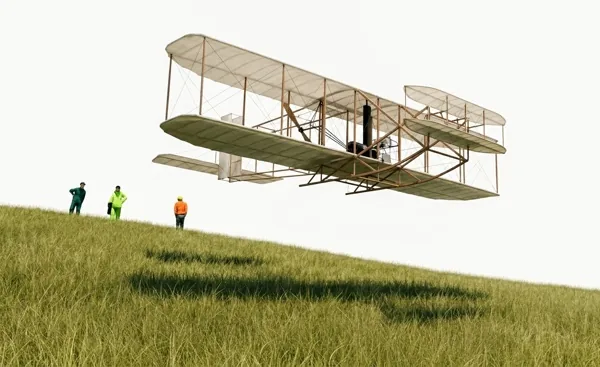
At first glance, a bicycle doesn’t have much in common with an aircraft, but after one of the brothers, Wilbur, had spent three months reading up on how far aircraft development had come, he concluded that an aircraft depends on three components:
- Wings – to provide lift
- An engine – to create thrust
- A control system – so the pilot can manoeuvre the aircraft.
Which component was most critical? Until then, the broad view had been that a light but powerful engine was the most important thing: “Give us a light engine, and we’ll soon have a successful aircraft,” said the aviation enthusiast Sir Hiram Maxim, who crashed his aircraft in 1894 because he couldn’t steer it. So Wilbur didn’t put much weight on the engine. As he sarcastically wrote in his notes: “It is possible to fly without motors, but not without knowledge and skill.” Wilbur’s reasoning was that engines fail from time to time – and so, then, does an aircraft. As long as you have control of the aircraft, it can glide and still land safely. Today it sounds obvious, but back then it was a unique line of reasoning (P. Johnson-Laird, 2004).
The Wright brothers then made another decisive piece of reasoning: “An aircraft is like a bicycle. It isn’t stable. With practice, the rider can learn to balance and control it.” Unlike Langley, the Wright brothers therefore didn’t try to stabilise their aircraft, but to control it. The rider of a bicycle steers by turning right and left. In the same way, the pilot has to be able to turn right and left as well as up and down. So it’s the pilot who keeps the balance – not the aircraft itself. This reasoning meant the brothers started on the controls first, long before the engine. The aircraft’s propeller was another challenge. Until then, people had believed it worked like a ship’s propeller. There, it’s shaped like a screw drilling its way through the water, but the same method gave no thrust in the air. The Wright brothers instead used the analogy of the aircraft’s wings. They made two mini wings and put them together, which gave them thrust.
Langley worked from a different method. Instead of using analogies, he used what’s known as trial and error, where you test and correct mistakes. The method is scientifically recognised, because the results are based on empirical evidence. That means the results are very reliable – but they also come very slowly. He worked intensely on making the aircraft stable and built small model aircraft with mini steam engines, which he launched with a catapult, corrected small mistakes, and tried again. The Wright brothers’ radical analogy to bicycles meant they pulled markedly ahead of their competitor and won.
“An aircraft is like a bicycle. It isn’t stable. With practice, the rider can learn to balance and control it.” The Wright brothers
The brother Wilbur lived to see the aircraft industry develop jet planes, helicopters and bombers. Just before his death in 1948, he gave an example of his strength with analogies. Asked whether he regretted having taken part in the invention of something that had caused so much death and destruction, he answered: “I regret the destruction fire has brought with it. But I believe it is good for humanity that someone invented how to make fire, and that it is possible to put fire to thousands of different, important uses.”
Start where it makes no sense
The Wright brothers showed they could work faster than a respected scientist from Harvard by using a radical analogy. Instead of making prototypes, testing them and adjusting them, they used their knowledge of bicycles and compared the bicycle to an aircraft.
When I meet teams who need to think in new ways, I often find they use analogies that sit far too close to each other. For example, we often compare a work team to teams from the world of sport. Analogies that sit close together can certainly produce good ideas, but nothing that really moves your team. That takes an analogy that sits a long way from your starting point. You have to go all the way out to where the comparison doesn’t obviously make sense. That’s where radical innovation starts (C. Herstatt, 2005).
When I meet teams who need to think in new ways, I often find they use analogies that sit far too close to each other. For example, we often compare a work team to teams from the world of sport.
Radical innovations are rare, but when they happen, they change the world. That’s why they’re often the foundation of some of the world’s biggest companies – like General Electric (the light bulb), AT&T (the telephone), IBM (the computer), Ford (the car), Sony (the Walkman) and Apple (the smartphone). Even if your ambition isn’t necessarily to change the world, it may well be that you have to think radically. Maybe you’re IT entrepreneurs at Symbion, researchers at Novo Nordisk or engineers at LEGO. Whatever the case, a brilliant reinvention of your company, collaboration or product starts where you make sense of something that doesn’t obviously make sense.
So I’d recommend inviting a meteorologist for coffee to compare your customers to a cloud. Having lunch with a potamologist to compare your team to a river. Calling a physicist to compare your organisation to the atoms in a carbohydrate. Radical new thinking doesn’t come from talking to the same people you always do. That only makes things marginally better.
Sources and more inspiration
The Influence of Shared Mental Models on Team Process and Performance
J.E. Mathieu, 2000, Journal of Applied Psychology
Information Acquisition and Mental Models
B. Vandenbosch, 1996, Information Systems Research
P. Johnson-Laird, 2012, The Oxford Handbook of Thinking and Reasoning
Flying Bicycles: How the Wright Brothers Invented the Airplane
P. Johnson-Laird, 2004, Mind & Society
How to Use Analogies for Breakthrough Innovations
C. Herstatt, 2005, International Journal of Innovation and Technology Management