
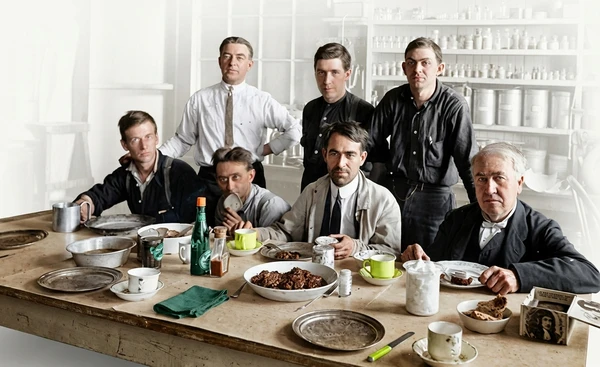
Behind every company’s success there are often strong teams. A close group of committed people who make each other better. When we think about productivity, we often focus on the individual – but it’s by optimising the team that a project can truly reach its next level. Thomas Edison is a really good example of that.
In 1876, a 29-year-old young man moved into a small villa in the town of Menlo Park in the state of New Jersey, USA. His name was Thomas Edison, and he would later become world-famous for all his inventions. But there was one fundamental idea that laid the foundation for all of Edison’s inventions, and that was his way of thinking in teams. Back then, professional groups didn’t get involved in each other’s work. They researched and worked on their inventions individually, each in their own laboratory. Edison put together a team made up of a machinist from England, a German glassblower, a Swiss watchmaker, a mathematician and a carpenter – and so revolutionised the way people worked together in research. It’s the same method companies like Apple, Microsoft and Google fundamentally use to this day (Time 1, 2013).
A team out of necessity, not by choice
Edison didn’t put his team together by choice, but out of necessity. From childhood he had very poor hearing, alongside a huge curiosity. Today he’d probably have been diagnosed with ADHD; the teachers thought he was stupid, and Edison was thrown out of school. To satisfy his curiosity, his mother set him up in the town library, where, at the age of 11, he read every one of its books. Edison taught himself, never got a diploma, and had to get help from a team in what he called his invention factory.
There was one fundamental idea that laid the foundation for all of Edison’s inventions, and that was his way of thinking in teams.
The reason we credit Edison with the inventions is that it was his name on the patent applications – but if you stood in the laboratory, you probably wouldn’t be able to tell him apart from the other team members. When you dig into the descriptions of how they worked together, it can be characterised as what we know today from high performance teams. You can see it, among other things, in their results: Edison got his first job at 15 and was working right up until his death at 84. Out of his total of 1,093 patents, he filed over 400 patent applications in the 4 years the team worked in the small villa, and laid the foundation for General Electric (T. Edison, 1971). As Edison himself put it: “Teamwork is what makes ordinary people achieve extraordinary results.”
Contrary to what many people believe, it wasn’t Edison and his team who invented the light bulb. That had been done 40 years earlier. They developed it further by making the light softer, got it to burn longer and devised the whole electrical infrastructure, so the bulb became usable in the home. They also developed the business model behind electricity by inventing the electricity meter, and so created an engine for the spread of the power grid (Time 2, 2013). Out of all Edison’s inventions, his most important contribution to the world was his way of thinking about teamwork.
“Teamwork is what makes ordinary people achieve extraordinary results.”
Thomas Edison
A fierce focus on real value
Just like today, in Edison’s time there was competition to invent and develop new things. What made Edison’s team unique was not their access to money, technology or their strategy, but the team’s ability to overcome any barrier. When the tools to create an idea didn’t exist, they developed them themselves. The same pattern can be seen in effective teams today. When they meet a barrier they can’t overcome with existing methods and processes, they invent new ones. Edison’s team had a clear, fierce focus on creating commercial value for the customers. It was a focus that, as a result, made them beat their competitors. By contrast, you also see teams that focus on the competitors or their own needs – and lose as a result, because they don’t focus on creating value for the customers.
Edison’s team was almost unbeatable. They drew on each other’s resources and together laid the foundation for one of the world’s biggest companies, General Electric. That’s because when a team paddles in the same direction, it can dominate any industry and any market, and hold its own against any competitor at any time.
The principles for working as a team are the same, whether the focus is global or local. Whether you sit in a small company of 17 people, or you’re a member of Edison’s General Electric’s 17-strong board, which according to Wikipedia represents over 300,000 employees, it’s your ability to effectively be one unit that decides whether you produce strong results.
Edison’s team had a clear, fierce focus on creating commercial value for the customers. A focus that made them beat the competitors.
Think of the potential
Next time you look at the world with this story in mind, you’ll quickly notice that whether your role models are legendary leaders, famous athletes or brilliant inventors, their heroic achievements are usually built on a group of people who, in the background, managed to work as a team. The word ‘team’ is often used so loosely that it loses its meaning and gets in the way of the discipline it takes to go from being a working group to being a team. Only when you accept that your colleagues are superhuman when you stand together as a team are you ready to overcome the first barrier, which is trust – and that’s what next Monday’s email is about.
Differences between a working group and a team (D. Forsyth, 2013)
| Working group | Team |
|---|---|
| Individual accountability | Individual and shared accountability |
| Meets to share information and perspectives | Meets often to discuss, make decisions, solve problems and plan |
| Focuses on individual goals | Focuses on shared goals |
| Creates individual solutions | Creates shared solutions |
| Each member has clearly defined roles, responsibilities and tasks | Each member has clearly defined roles, responsibilities and tasks, which are often shared and rotated |
| Each member cares about their own results and challenges | Each member cares about the team’s results and the team’s challenges |
| Purpose, goals and approach are defined solely by the leader | Purpose, goals and approach are defined by the leader together with the team |
Sources and more inspiration
The Real Wizardry of Edison’s Menlo Park Lab
Time 1, 2013
The Diary of Thomas A. Edison
T. Edison, 1971, Viking Press
Thomas Edison and the Electric Light
Time 2, 2013
Group Dynamics
D. Forsyth, 2013, Wadsworth Publishing Co Inc