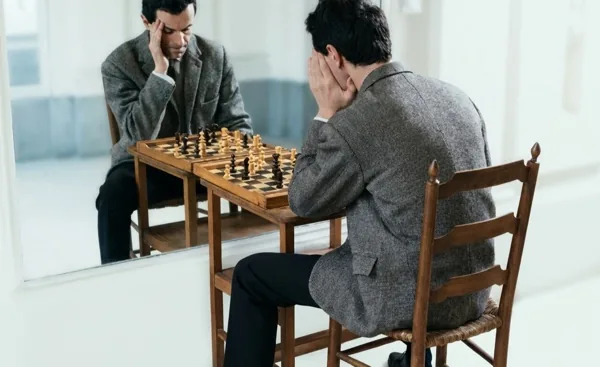

A good day isn’t a day without conflicts with your colleague — it’s a day where you actually get something good out of your conflicts. Conflict matters for the results you and your colleague create (K. Jehn, 2001). If you’ve built yourselves a cappuccino relationship, where you slip off to the coffee machine to dodge things, it might be time to try something more effective.
It’s about diving below the surface of the water together and trusting that your relationship won’t be weakened when your differences and disagreements come into view. Backbiting and corridor talk are the worst things there are. That’s because you keep the conflict alive by merely scratching the surface and blaming the other person. Have a deep dialogue, and make the decisions it takes for you to move on. So take a deep breath, and dive below the surface.
It’s about diving below the surface of the water together and trusting that your relationship won’t be weakened when your differences and disagreements come into view.
Don’t think teamwork is about creating harmony. A team in total harmony, with no conflict, is also a team that’s about to fall asleep. Conflict keeps us focused and drives the will to compete. So where do you draw the line between harmony and conflict with your colleague?
The table shows that if you don’t like each other and disagree at the same time, the hostility between you will be 12 times higher than if you like each other and agree (F. Taylor, 1970). It really does pay to keep a good chemistry going during a discussion.
Person-related conflicts are often harmful to both a team’s results and its happiness at work — but not necessarily. Your hostility, and therefore your conflicts, depends on whether you like each other or not. When your colleague doesn’t doubt your relationship and is comfortable speaking their mind, your passionate, emotionally charged discussions will create a high degree of professional engagement and motivation for the agreements you make (B. Bradley, 2012).
| When you agree | When you disagree | |
|---|---|---|
| If you like each other |
1 |
1 |
| If you don’t like each other |
2 |
12 |
Don’t think teamwork is about creating harmony. A team in total harmony, with no conflict, is also a team that’s about to fall asleep.
On a personal level, it’s a clear advantage if you like each other, because it means you can throw a ball in the air and suggest a new way of solving the tasks, even when your colleagues don’t agree. When you throw a ball in the air, use the conflict method that best suits the situation (K. Thomas, 1977).
Which conflict method should you use in which situation?
- The competing one: “I’m right. You’re wrong.” This method is dramatic and can come across as aggressive. It’s good if both parties are up for competition, because it creates engagement. It doesn’t work if your colleague can’t express themselves in this mode when you put your foot on the accelerator.
- The avoiding one: “Let’s agree to disagree.” This method ignores and denies that there’s a conflict at all. You have no desire or motivation to confront it. It’s good if you think the conflict isn’t worth fighting for, or if you need time to think. It’s bad, on the other hand, if the conflict is important and won’t go away on its own.
- The accommodating one: “You get to be right. I get some peace.” Here you smooth things over or give up, and it works when it’s important that you and your colleague have a good relationship right here and now. It’s bad if it’s a good moment for your colleague to take the conflict on.
- The compromising one: “Let’s meet in the middle.” The method where you both give a little. It’s good if the alternative is that one party wins and the other loses. It’s bad if the solution is too watered down, because it can be hard to get both parties to commit to the agreement.
- The collaborating one: “Win-win.” The solution that’s even better for both parties than the original starting point. Here you find a solution with mutual agreement and respect. It’s good because you’re both equally keen to commit — but it can also be time-consuming.
When your colleague doesn’t doubt your relationship, your passionate discussions will create a high degree of professional engagement and motivation.
Just as the person who’s good with a hammer sees nails everywhere, the classic pitfall is using the same method for every kind of conflict. Conflicts in different situations call for different approaches.
Sources and more inspiration
The Dynamic Nature of Conflict: A Longitudinal Study of Intragroup Conflict and Group Performance
K. Jehn & E. Mannix, 2001, Academy of Management Journal
K. Jehn, M. Neale, 1999, Administrative Science Quarterly
H. Taylor, 1970, Van Nostrand Reinhold
B. Bradley, B. Postlethwaite, A. Klotz, M. Hamdani & K. Brown, 2012, Journal of Applied Psychology
Developing a Forced-Choice Measure of Conflict-Handling Behavior: The “Mode” Instrument
K. Thomas & R. Kilmann, 1977, SAGE Publications