
Strategies for giving the team the best conditions to succeed.

Team coaching has proven hugely effective as team development. But as a leader, how do you know whether the team really needs developing right now? When will your team coaching deliver the most, and which pitfalls should you steer around? Get the answers here.
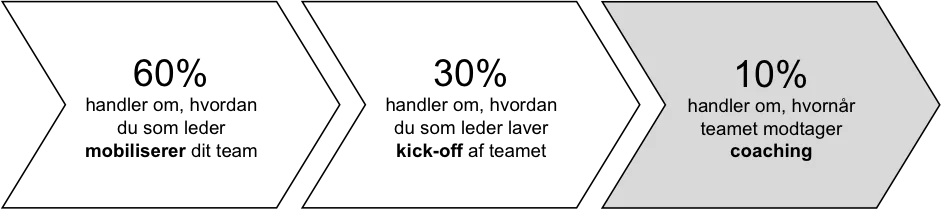
| This is the third and final article in the guide to how you, as a leader, give your team the best conditions to succeed. The guide is built on the so-called 60/30/10 rule for teams. The rule was formulated by the respected professor Richard Hackman at Harvard University, and it says that 60 % of the team’s result is determined by how you mobilise your team, and 30 % by how you run the kick-off. This article is about the last 10 % — that is, how team coaching boosts your effectiveness. |
In 1911, the American car dealer Ralph Hankinson had the idea of using auto polo to drum up PR for the Ford Model T cars he was selling (Carlebach, 2012). Two cars per side and eight players had to knock the ball into the opponents’ net with a mallet. The event was an instant hit. The first match drew 5,000 spectators, and The New York Times could report that the game between the Red Devils and the Grey Ghosts ended 1:1 (The New York Times, 1912). There were no injuries, even though one of the cars did a somersault. Auto polo quickly spread across the rest of the country. Clubs were formed and leagues were played. During a match, the cars could hit a top speed of more than 60 km/h, which is why injuries were common — players were run over or thrown into the air in collisions. Auto polo stopped being played in the late 1920s because cars were so expensive.
Working in a team that gets no team coaching is a bit like playing auto polo. High speed and no seatbelt raise the risk of collisions and flying drivers. Team coaching is your seatbelt — a seatbelt that keeps your effectiveness intact even when you’re moving fast. An effective team is, in most cases, also a team where communication is good and the members are good at looking after each other. So team coaching is also about not ending up in needless conflicts or burning out from stress.
Sadly, far too many teams forget their seatbelt. In a study of 95 cross-functional teams from 25 different companies in the US, professor Tabrizi of Stanford University found that 75 % of those teams weren’t working (Tabrizi, 2015). Another study, from 2012, showed the same trend. University of Phoenix interviewed 1,019 Americans, of whom 68 % said they had at some point worked in a team that didn’t work (University of Phoenix, 2013).
In this article I describe how you, as a leader, make the best use of team coaching — so you can spot whether the team needs coaching, so you know when the team gets the most out of your coaching, and so you know the classic pitfall to steer clear of. Coaching is an important theme, which the American researcher Richard Hackman reckoned makes up 10 % of the team’s fate (Hackman, 2002).
What has the biggest influence on the team’s results? (Hackman, 2011)
What is team coaching about?
At the broadest level, team coaching is about getting the members to make the best use of each other’s resources, so the team creates the best possible result. Where the leader personally coordinates the team’s work or tries to secure more resources for the team, a coach will typically work on making the teamwork more effective. The leader can take on the coach role themselves, or choose an external coach.
Where mobilising the team (60 %) and the kick-off (30 %) are things that happen before the task or project has begun, coaching (10 %) is mainly relevant once the team’s work is under way. Here the coach will focus on boosting the team’s effectiveness, where three elements in particular have the biggest influence (Hackman, 2002). The first element is about the effort the team puts in. Here team coaching has the role of engaging the members, so everyone has the same focus on the task. The second element is about whether the team has the right approach, or uses the right strategy, to solve the task. Here the team coach will typically use feedback as a tool with the team to sharpen the members’ analytical work. The third and final element is about the knowledge and skills the team has to solve the task. Here the team coach will ask the team reflective questions about its decisions. That gives the members the chance to make better use of their knowledge and experience.
Working in a team that gets no team coaching is a bit like playing auto polo. High speed and no seatbelt raise the risk of collisions and flying drivers.
What creates headwind and tailwind for the team’s effectiveness
| Area | Headwind | Tailwind |
|---|---|---|
| 1. The team’s effort | Not every member pulls their weight | Build high engagement, so everyone has the same focus on the task |
| 2. The team’s task strategy | The team relies uncritically on old routines | Develop new procedures that fit the tasks |
| 3. The team’s knowledge and skills | The members don’t weigh each other’s contributions correctly | Knowledge sharing and developing the team’s skills through debriefing |
The purpose of team coaching is to support the team in improving all three.
At the broadest level, team coaching is about getting the members to make the best use of each other’s resources, so the team creates the best result imaginable.
How to tell whether the team needs coaching
To decide whether your team needs coaching, you have to assess whether the team is effective. Here you should ask the following questions:
- Does the team meet the end user’s expectations?
Whether a team is effective can be judged by whether the team meets or exceeds the task’s requirements for quality, quantity and deadlines. The task could be, for example, a product, a service or a decision. It’s the end user of the team’s work who should assess the team’s product, not the team itself. The end user can be internal customers (for example another department in the organisation), or external customers (for example citizens). There are relatively few tasks where the team is also the end user. - Does the team work independently?
Another measure that reveals whether the team is effective is how good the team is at working independently. Can the team, for example, spot and correct its own mistakes? You can also look at whether the team has become a more tightly knit unit once a task is done than when it started. - Is the team learning, and is it thriving?
Finally, an effective team can be judged by whether there is good learning and wellbeing in the team. Relationships can be messy, but the members’ overall experience of learning and wellbeing should be more positive than negative.
The individual factors can carry different weight in different circumstances, but in general they all have to be met. A team won’t be effective if it neglects one criterion and focuses on the other two.
Whether a team is effective can be judged by whether the team meets or exceeds the task’s requirements for quality, quantity and deadlines.
What creates the most value for the team across the course of the task
| The course of the task or project | At the start | Halfway | At the end |
|---|---|---|---|
| What team coaching will focus on | Synchronising the members’ engagement through a kick-off | Improving the strategy the team uses to solve the task | Boosting knowledge and skills through a debriefing |
| The format of the team coaching | Motivating | Advisory | Educational |
Source: Hackman, 2002
When does the team get the most out of coaching?
Many organisations already use coaching, but most often at an individual level — which is a bit of a paradox. The reason is that learning happens mainly in groups, so individual learning is a by-product of the team’s learning. Maybe it’s because many leaders are a little unsure when to make use of team coaching. Research points to three moments in the course of a task where team coaching does the most good.
At the start: targeted engagement is everything
At the start of a task, the members will naturally be unsure of their roles, their responsibilities, the task’s purpose, its vision and which strategy to use.
“Can I handle the task?”
“Is there enough time?”
“Will my contribution to the team be valuable?”
“What are the others like to work with?”
The individual members can be holding plenty of questions before the work really gets going. A good way to answer these questions is to draw up a so-called Team Charter, which I described in my last article. A Team Charter can be described, in short, as a structural “shell” of agreements about good and bad behaviour, values and norms for how the members work together.
This means team coaching at the start has two important purposes: to draw up a structural “shell” for the teamwork, and to make sure the team and the leader also breathe life into their agreements. It can sound simple, but the devil, as we know, is in the detail. What the team agrees at the start matters greatly for everything that follows (Gersick, 1988). Teams are different and have different needs. So two Team Charters will look different too. After that, the art is getting the team to live by the agreements. Here team coaching plays an important role in motivating and engaging people around those agreements.
In other words, it’s important to target the members’ engagement, so nobody coasts along, and so the team builds a sense of belonging around its tasks, its behaviour and the collective.
Team coaching at the start has two important purposes: to draw up a structural “shell” for the teamwork and make sure the team and leader breathe life into their agreements.
Halfway: advice gets the team to adjust the strategy
Once everyday life has set in and the energy from the good kick-off is fading, the team needs to take a fresh look at how best to approach the task.
Two questions are relevant here:
- Which of our processes are no longer effective?
- Which methods should we adjust?
The purpose of the questions is to get the members to reflect on whether there’s a better way to work. It’s important that the team keeps inventing new ways to create momentum as the task changes, rather than “just doing what it’s told”.
Whether or not the team works to a deadline, it will need to stop and pause halfway. An operations team — an accounts department, say — will typically have tasks both with and without deadlines. Either way, it will be of great benefit for the team to stop and evaluate the effectiveness of its workflows, methods and processes.
Where team coaching at the start mainly focuses on the members’ relationships with each other, researchers have studied the effect of repeating that type of coaching versus coaching focused on the task strategy. A study with 90 participants gave a clear answer (Woolley, 1998). The participants competed for 50 minutes to see who could build the best house out of LEGO. Points were awarded for number of floors, number of rooms, sturdiness and aesthetics. All the teams got coaching halfway through the project. One half received the same type of coaching as at the start, focused on relationships. The other half received coaching focused on the team’s task strategy. Afterwards the participants rated the value of their coaching. The participants whose coaching had focused on the task strategy judged it to have been twice as valuable as the participants whose coaching had focused on the mutual relationships.
So the team gets the most out of its coaching halfway through the task when it’s advisory in nature. That’s why it’s important, as a leader, not to let yourself be distracted when feelings in the team are running high.
At the end: a debriefing lifts the team’s knowledge and skills for the next task
When the team has finished its task, or completed an important part of it, there’s a chance to gather up important learning in a so-called debriefing (Dufrene, 2014). This meeting focuses on what the team has learned along the way, and makes sure the explanations for the task’s outcome also match reality. So a debriefing helps educate the team and make it even better for the next task.
Sadly, many teams tend to deprioritise a debriefing, and there can be several natural reasons for that. If the team has created a good result, it usually most wants to celebrate the success. Conversely, there’s a tendency to rationalise a poor result after the fact as being down to other people’s mistakes or bad luck. Finally, failing to prioritise a debriefing is about this meeting not being part of the organisation’s culture. It’s simply something that’s never been done.
My experience with debriefing teams is that it gives the members a boost of renewed hope, and with it energy. Mentally, it means a lot to the team to get the chance to exchange good and bad experiences. The members get a full stop that always gives fresh energy for the next task.
The military and the health service have long experience with debriefings, and the model below was developed for hospitals, but it can also be used in other organisations. When you facilitate a debriefing, it’s important that you help the team explain the task’s outcome. In my experience, it can be hard for the members to put into words why they performed the way they did.
How to run a good debriefing
Use this template for your next debriefing. It can take anywhere from 5 minutes to 2 hours. When you meet, I recommend you don’t sit down, but make it a stand-up whiteboard meeting. That creates more energy and makes your debriefing more effective. Not every participant necessarily sees the value of a debriefing, which is why it’s important that it’s a short meeting to begin with. In the beginning, the most important outcome doesn’t necessarily have to be that everyone on the team gets wiser. Maybe it’s first about getting the members to acknowledge that reflection between tasks must be prioritised, so the team doesn’t repeat its mistakes.
| When the task is done | |
|---|---|
| What happened? | Let one person describe the task as objectively as possible |
| How did it go? | What went well? Why? |
| Address concerns | What didn’t go so well? Why? |
| Go through the learning points | What did you learn about your professional skills? |
| What did you learn about your collaboration skills? | |
| What did you learn about the team’s skills? | |
| Plan ahead | What can you do to improve going forward? |
| What can the team do to improve going forward? | |
Source: Arora, 2018
The pitfall: boosting the team’s effectiveness through good relationships
Many leaders and team members imagine that team coaching is meant to smooth out differences and harmonise the members. It also feels natural to head in that direction, when one of the criteria for an effective team is learning and mutual relationships. So it can seem paradoxical that the purpose of team coaching should precisely not be to improve the members’ mutual relationships.
If the team has created a good result, it usually most wants to celebrate the success. Conversely, there’s a tendency to rationalise a poor result after the fact as being down to other people’s mistakes or bad luck.
The reason is that teams don’t automatically become effective through good relationships. I’ve met plenty of teams that were great at drinking red wine and being social together, but weren’t great at working together on the task. Professional and social belonging can be two very different things.
Imagine a team that struggles to deliver results. Such a team will typically experience poor communication, conflicts and problems with its leader. The classic mistake is to think the team solves the problems by improving the members’ mutual relationships (Mannix, 2001). But just because most effective teams also have good relationships with each other doesn’t necessarily mean you can create an effective team by creating good relationships in the team. Put another way: there may well be a correlation between the team’s relationships and its effectiveness, but there doesn’t have to be a causal link.
In fact, the evidence suggests we judge the members’ mutual interaction by the results the team delivers. One study showed (Calder, 1975) that a team’s perception of its results affects the way the members think they interact with each other. In the study, two groups of teams were given a task, which they all solved satisfactorily. One group of teams was told they had performed well. The other group of teams was told they had performed poorly. Each team was then asked to evaluate how they had functioned during a task. The teams who had been led to believe they had done poorly also judged that their team functioned poorly. The teams who had been led to believe they had done well judged the opposite — that their team functioned well.
The point is that we typically make two mistakes when we want to boost the team’s effectiveness. The first mistake is judging how the members interact by the results the team creates. The second mistake is believing we can make the team more effective by improving the members’ mutual interaction.
Focus instead on boosting the team’s engagement, improving the team’s task strategy, and getting the team to gather up its experiences in a closing debriefing.
Make a plan for your team development
The demands on teams’ effectiveness are rising. They’re rising because teams’ tasks are growing more complex. The days when team development could be handled with a couple of social events a year are long gone.
At a minimum, members today have to be able to coordinate their effort, so everyone pulls together. They have to be able to cover each other’s tasks to avoid bottlenecks. If the team’s effectiveness is low, it has to be able to diagnose why and solve the problem. The members have to be able to set goals and resolve conflicts among themselves, so their relationships are strengthened — and finally, the team has to be good at communicating, leading and making decisions (Salas, 2017). For some teams, all of this has to happen across time zones, geography and cultures. None of it comes by itself. It takes targeted team development through coaching.
So I hope you, as a leader, have been inspired to make a plan for your team’s development. It raises the odds that you’ll succeed — and when that happens, you each go home with a feeling that you’ve created something you could never have done alone. That’s why we look forward to going to work.
Sources
Bain’s New York: The City in News Pictures 1900–1925
Carlebach, 2012, Dover Publications
1912, The New York Times
75 % of Cross-Functional Teams Are Dysfunctional
Tabrizi, 2015, Harvard Business Review
University of Phoenix, 2013
Leading Teams: Setting the Stage for Great Performances
Hackman, 2002, Harvard Business Review Press
Ericksen, 2004, Administrative Science Quarterly
Hackman, 2005, Academy of Management
Successful debriefing — Best methods to achieve positive learning outcomes: A literature review
Dufrene, 2014, Nurse Education Today
Time and Transition in Work Teams: Toward a New Model of Group Development
C. Gersick, 1988, Academy of Management Journal
Effects of Intervention Content and Timing on Group Task Performance
A.W. Woolley, 1998, The Journal of Applied Behavioral Science
The London Handbook for Debriefing
Arora, 2018, Imperial College London
The Dynamic Nature of Conflict: A Longitudinal Study of Intragroup Conflict and Group Performance
Jehn & E. Mannix, 2001, Academy of Management Journal
Self-perception of intrinsic and extrinsic motivation
B.J. Calder, 1975, Journal of Personality and Social Psychology
The Wiley Blackwell Handbook of the Psychology of Team Working and Collaborative Processes
E. Salas, 2017, Wiley-Blackwell