
Strategies for giving your team the best conditions to succeed.

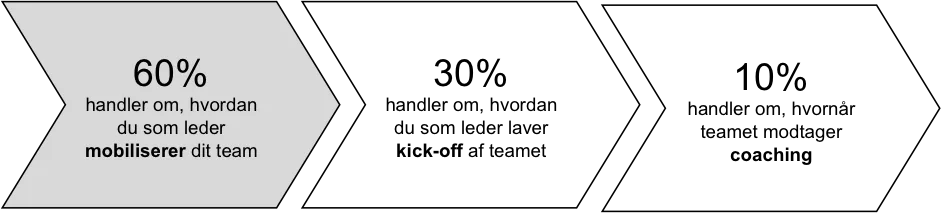
There very much are. In fact, research shows that you, as a manager, have the greatest influence on your team’s results before the team’s work has even begun. That’s why I’ve written a guide for you, if you want to place your team on the front row. The guide is built on the so-called 60/30/10 rule for teams. The rule was formulated by the renowned Harvard University professor Richard Hackman and says that 60% of the team’s result is set by how you mobilise your team, and 30% is set by how you do the kick-off. The last 10% of the team’s result is set during the work itself, and is about when the team gets coaching. In this article, we focus on how you mobilise your team.
| This is the first article in the guide to how you, as a manager, give your team the best conditions to succeed. The guide is built on the so-called 60/30/10 rule for teams. The rule was formulated by the renowned professor Richard Hackman at Harvard University and says that 60% of the team’s result is set by how you mobilise your team, and 30% is set by how you do the kick-off. The last 10% is about how team coaching boosts your effectiveness. |
The teacher comes into the classroom and asks each pupil to make a paper ball: “The exercise is simple: you each represent the population of a country,” says the teacher, and goes on: “Everyone in your country has the chance of a good education, a good job and good savings. All it takes is for you to hit the wastepaper basket from where you’re sitting.” The pupils then throw their paper balls. None of the pupils on the back rows hits the basket. Most of those on the front row, on the other hand, do. The teacher sums up the exercise: “Those of you sitting on the front row had good chances of hitting the basket. You were privileged and had some particularly favourable conditions. You hadn’t done anything to earn it. It was simply your luck. You on the back row also had the chance to succeed. It was just very small.”
The classroom exercise can be transferred to teams: some teams are privileged and sit on the front row. Here it’s easy to be efficient, hit deadlines and keep spirits high. It’s as if the teamwork just clicks into place from the start, without the team members themselves knowing exactly why. Often they have so much spare capacity that they become high-performance teams. The teams sitting on the back row don’t have anything like the same chances. They mainly spend their energy on conflict and struggle to succeed at even the most basic tasks.
If you, as a manager, work from the 60/30/10 rule, you give your team the best possible privileges and place it on the front row.
What has the greatest influence on a team’s results? (Hackman, 2011)
Mobilising your team
The conditions in place when a system is created have a greater influence on the system’s development than any other factor. That goes for everything from the conditions at the birth of the universe to living organisms like teams. That’s why mobilisation is the condition with the greatest influence on a team. When you mobilise your team, you should ask yourself the following questions:
60% of the team’s result is set by how you mobilise your team.
Do I need a team or a working group?
5 people can clean a school in 10 hours. If there are 10 times as many of them, they can do it in one hour. We might call them a team, but really they’re a working group and don’t need anything like the same preparation a team does. Whereas the members of a working group work independently of each other, a team has to collaborate to solve the task. In a team, the task requires the members to plan, solve problems and make decisions together. Creating a team requires you to invest time. A working group doesn’t. So ask yourself whether it’s a working group or a real team you need. You could read my earlier article on the differences between a team and a working group here.
How do I choose the right members?
In practice, the challenge is often that the manager doesn’t have a big pool of staff to choose from. If you put your team together on the thought “I’ll take whoever I can get,” then the chances of creating a high-performance team are probably very small. Putting together the right team takes both careful thought and political agility within the organisation. Here are three factors that will have a big influence on your team:
- Number of members. The bigger the team, the more resources its members have to spend coordinating and understanding each other. That slows things down and quickly raises the risk that some members coast along. There’s no fixed rule for how many people a team should have, but typically people talk about 2 to 9. The so-called Ringelmann effect (Ingham, 1974) shows that members coast along when the team is larger than five people, if not everyone can identify with the task, or if the goal is unclear (Simms, 2014).
. - Diversity. Depending on the team’s purpose, the members should be different if you want fresh thinking, but similar if the task is generic. Research into diversity (Knippenberg, 2007) suggests that differences in education and job function have a positive effect on the team’s performance and engagement. Differences in values, on the other hand, have a negative effect on the team’s performance and happiness at work. Finally, differences in gender, age and ethnicity have no direct effect on the team’s performance, but they do have a positive effect on the team’s happiness at work, engagement and desire to stay in the team.
. - A constructive approach. It’s not enough to assess a potential member on professional skills alone. Collaboration is just as much about being able to make up for others’ missing skills. One rotten apple can spoil the whole barrel. Research shows that a member who consistently coasts along, speaks negatively and breaks the team’s norms ruins the teamwork for the others (W. Felps, 2006). An easy way to get insight into a potential member’s collaboration skills is to ask the previous teams the colleague has been part of.
If you put your team together on the thought “I’ll take whoever I can get,” then the chances of creating a high-performance team are probably very small.
Will the team’s members have time to get to know each other?
Members who know each other well perform better. You might think that members who know each other too well get a little too comfortable and slowly lower the bar for the team’s quality and punctuality, and that a steady turnover keeps everyone’s senses sharp. A team with no turnover of members has a healthier dynamic and generally performs better than teams with turnover. As an example, a study of plane crashes from 1978 to 1990 concluded that 73% of the accidents happened on the captain’s and pilot’s first working day together. Of those, 44% of the accidents even happened on their very first flight together (NTSB, 1994).
There are several reasons why stable teams perform better. Members who know each other can concentrate on the task rather than having to spend time getting to know new colleagues. They know each other’s unique skills, which means they can draw on each other’s knowledge and experience. New members can’t. Finally, they also share mental models, which makes it easy to communicate. I’ve described mental models before in my article “The power of analogies”. A mental model is, for example, a shared understanding of what we mean when we agree to meet at 9. Is that 08:55, 09:00 or 09:05? A new member doesn’t share that understanding.
Teams that know each other well, on the other hand, have the main challenge that they can become change-blind. That happens when the team runs on autopilot. It relies so much on its routines that it doesn’t notice a change that makes the routine it’s following now redundant. Here it can be good to have a visit from an outside guest who asks four short questions: “Why do you do it this way?”; “Who does that routine create value for?”; “How do you know?”; “What new routine could replace two old ones and save you 50% of the time?”
A study of plane crashes from 1978 to 1990 concluded that 73% of the accidents happened on the captain’s and pilot’s first working day together. Of those, 44% of the accidents even happened on their very first flight together.
How do I give the team a compelling purpose?
For the team to perform, it has to know what it’s doing and why it matters. In other words, a good purpose should:
- Be clear — so it orients the team. Paradoxically, the problem with purpose statements is rarely that they’re ambiguous, but that they’re spelled out in every detail. Leave a little room for the team to put its own stamp on the purpose. That creates ownership.
. - Be challenging — so it motivates the team. Our motivation is greatest when we judge the chance of success to be 50% (J. W. Atkinson, 1957). The same goes for teams.
. - Make a difference — so it engages the team’s talents. It will always motivate the team when the members can see that the task will make a big difference in the organisation. A real difference. Drop the metaphor: are you building cathedrals, or cutting stone? That’s just rewording a dull task.
A good purpose should be clear, challenging and make a difference.
The “we lay the tracks as we go” attitude takes spare capacity
There’s a great deal you can do to give your team the best possible foundations. Unfortunately, I often hear phrases like: “We’ll deal with that as we go,” or “we lay the tracks as we go.” I hear it especially from managers who aren’t prepared. It’s as if the manager believes adaptability in the team can make up for a lack of planning. My experience is the opposite. Teams that are well mobilised, well kick-started and well coached are like privileged children. They sit right up on the front row and have the energy and spare capacity to lay the tracks as they go. They can do that because they know how to help each other when the task demands a change of strategy.
Sources
Collaborative Intelligence: Using Teams to Solve Hard Problems
Hackman, 2011, Berrett-Koehler Publishers
A Review of Flightcrew-Involved, Major Accidents of U.S. Air Carriers 1978 Through 1990
National Transportation Safety Board, 1994
Motivational Determinants of Risk-Taking Behavior
W. Atkinson, 1957, Psychological Review
Atkinson’s Theory of Achievement Motivation
Maehr, 1971, American Educational Research Association
How, When, and Why Bad Apples Spoil the Barrel
W. Felps, 2006, Research in Organizational Behavior
The Ringelmann effect: Studies of group size and group performance
A.G. Ingham, 1974, Journal of Experimental Social Psychology
Social Loafing: A Review of the Literature
Simms, 2014, Journal of Management Policy and Practice
Knippenberg, 2007, Annual Review of Psychology