
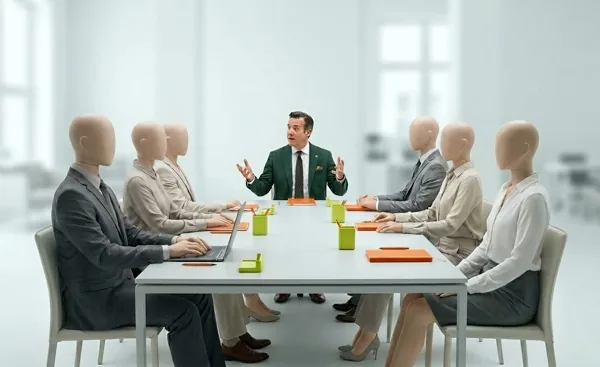
You know the silent majority. The only ones talking are the meeting leader and two others. It’s as if the rest have mentally checked out of the meeting. They sip coffee, eat biscuits and let their eyes wander when a question is asked. Why? Because commitment in a meeting room only emerges when there’s trust. Martin Luther King said you don’t need to see the whole staircase. You just have to take the first step. Of course, that’s easier said than done, but when you’re in a meeting room where no one says anything, that’s exactly what you have to do: take the first step. Here’s how to build trust in a team meeting – whether you’re the team leader, the meeting leader or simply an invitee.
First, we need to look more closely at why the silence sets in. Why are there some people who never say anything? Why is the meeting leader met with a deafening silence, where shoulders are shrugged and eyes turn down? Because trust is missing around the meeting table and in the team. A leader has a big influence on the trust in a team (K. Dirks, 2000), but that doesn’t mean it’s solely the leader’s responsibility (J. Driscoll, 1977). The classic pitfall is to tell yourself: “It won’t make any difference”, “I’m just invited to the meeting” and “There’s nothing I can do”. Trust only emerges when both the team and management reach out a hand. Trust is so decisive for your results and your colleagues’ that you simply can’t afford to wait for others to do something (A. Costaa, 2009).
So which first steps should you take to build trust in the team? When you take the first step, you have to be persistent. Don’t let it stress you if not everyone on the team gets behind your initiative straight away and just rolls their eyes. Halfway through, the whole thing can look like a failure.
Why is the meeting leader met with a deafening silence? Because trust is missing around the meeting table and in the team.
7 ways to build trust in a team meeting
- Choose the format
In meetings where you need to make decisions, there can’t be too many of you. Research shows that the optimal number of participants in a decision-making process is 4.6 people (R. Hackman, 2002). - Be together
Make sure everyone who’s invited is actually present at the team meeting. It’s important that you spend time together – even though there’s always someone who feels it’s a waste of time. A lack of trust is one of the biggest challenges for virtual teams, because they don’t spend time together in person (S. Sarker, 2011). You can’t build trust without being together. - Find solutions
Start from the belief that your team can succeed. Don’t tell them the idea isn’t the right one, or that the solution is wrong. You build trust by going into the dialogue positively and with a focus on solutions, no matter what. - Make a sacrifice
Sometimes the solution to a problem is your sacrifice. Be willing to be the solution to your colleagues’ problem. - Trust the team
You can’t start a positive spiral without taking the first step. Trust that you can succeed – even if the team doesn’t return your trust straight away. - Recognise and appreciate the team
Put energy into maintaining the relationship, and let the recognition come from within. It takes more energy to keep up a negative relationship than a positive one. - Break the pattern
It’s always easy for the team to hold on to a habit – even when it’s a negative one. When the chance arises, swap the team meeting for a walk.
Go beyond yourself
I once renovated a flat, and all the neighbours in the building were annoyed about the noise and dust. I had to do it after work, and it wasn’t ideal for any of us. When the renovation was finally finished, I bought a big basket of fruit, chocolate and flowers for everyone in the building. On top of that, everyone got a personal card: “Renovations always take longer, cost more and are noisier than expected. Sorry for all the hassle you’ve had. I look forward to showing you the result. Wishing you good neighbourliness. Martin.” Every neighbour, without exception, was thrilled. They’d never experienced anything like it. We got a markedly better sense of togetherness in a building where people typically didn’t even say hello. Investment? Small. Return? Huge.
Don’t let it stress you if not everyone on the team gets behind your initiative straight away and just rolls their eyes. Halfway through, the whole thing can look like a failure.
Teams that trust each other dare to have committed discussions about critical challenges. They dare to disagree, challenge one another and ask questions to find the right solution.
Sources and more inspiration
Trust in Leadership and Team Performance: Evidence from NCAA Basketball
K. Dirks, 2000, Journal of Applied Psychology
Trust and Participation in Organizational Decision Making as Predictors of Satisfaction
J. Driscoll, 1977, Academy of Management
Trust within Teams: The Relation with Performance Effectiveness
A. Costa, R. Roe & T. Taillieu, 2010, European Journal of Work and Organizational Psychology
Leading Teams: Setting the Stage for Great Performances
R. Hackman, 2002, Harvard Business School Press
The Role of Communication and Trust in Global Virtual Teams
S. Sarker, M. Ahuja, S. Sarker & S. Kirkeby, 2011, Journal of Management Information Systems