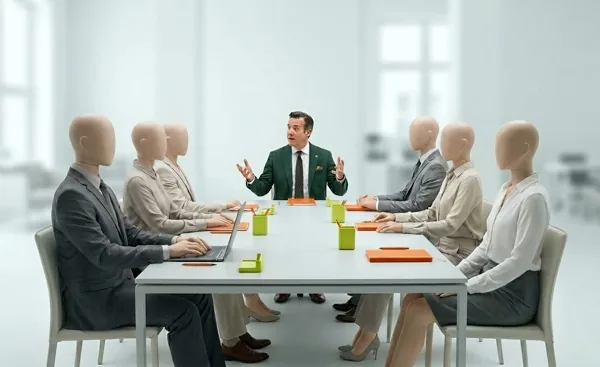

Analyses of stories from teams in extreme situations show that the teams that come to grief often die in confusion. Why? It could just as well be the restaurant that doesn’t understand where its guests have gone, or the manufacturer that can’t get customers to reorder. It starts with a confusion that turns deadly — because the company’s or the team’s view of the situation no longer matches reality. In my previous article I described how important it is for teams to share the same view of what the task is and how it should be done. When that happens, we say the team shares mental models. In this article I describe what happens when your view of the world is distorted, what you can do to avoid it, and the resistance you may meet from the companies or teams you are trying to help. We start with the lessons of one of the most important accidents in aviation history.
It was a Thursday afternoon, 28 December 1978. In the cockpit of United Airlines Flight 173 sat Captain McBroom (52), First Officer Beebe (45) and Flight Engineer Mendenhall (41), on their way from Denver to Portland International Airport in Oregon, USA. Captain McBroom, who had worked 27 years for the airline, had over 27,600 flying hours and was one of the company’s most experienced pilots. His colleague Beebe had 13 years’ seniority, and Mendenhall had 11. The flight was due to last two and a half hours and was pure routine.
As they were preparing to land, Captain McBroom pressed the button to lower the landing gear. A loud thud suggested the gear had come down, but the cockpit light meant to indicate it was down did not come on. So they broke off the landing and began circling the airport to find the fault. The crew were deeply absorbed in finding the fault with the light — sadly so absorbed that they forgot to keep an eye on the fuel level. After 63 minutes the plane ran dry and had to make an emergency landing in a forest some distance from the airport. With no fuel, the plane did not catch fire, which saved most lives. Of the 181 passengers, 10 were killed (R. Reynolds, 2009).
The aviation industry set out at once to investigate how such an experienced crew could make such a basic mistake. A pattern soon emerged from other crashes: in 1963 an Aeroflot Tu-124 ran into the exact same fault. In the cockpit, the crew focused on finding a fault with the landing gear and ran out of fuel after circling for two hours. SAS Flight 933 and Polish Airlines Flight 007 both came to grief — in 1969 and 1972 respectively — because the crew in the cockpit were far too focused on investigating minor instrument faults. The United Airlines Flight 173 accident became a milestone for the aviation industry, because afterwards the way pilots were trained was fundamentally redefined. Where training had focused only on technical skills, it now also included teamwork. For that reason, the United Airlines Flight 173 accident is regarded as one of the most significant accidents in aviation history (D. Noland, 2015).
The crew were deeply absorbed in finding the fault with the light — sadly so absorbed that they forgot to keep an eye on the fuel level.
The accident is, among other things, an example of the saying “The operation was a success, but the patient died.” Analyses of stories from teams in extreme situations show that the teams that come to grief die in confusion (L. Gonzales, 2003). A deadly confusion that begins when the team’s mental model no longer matches reality. It costs them their lives, because their mental models are the basis for their actions. So it is not enough for a team or a company to share a view of what their critical challenge or solution is, if that view does not match reality.
A team therefore has two challenges:
- They must share the same view — that is, share their mental models.
- Their shared view must match reality.
It may sound obvious, but when our shared mental model is not correct, we make the wrong decisions (M. Gary, 2008). That is why it is crucial to test whether our view actually matches reality before we make a decision. Since the vast majority of strategic decisions are made by teams, it is also crucial for the team to remember that just because everyone around the table shares the same view, that view is not necessarily correct.
It could be the leadership team that believes the organisation is mostly made up of lazy employees. The truth may be that the employees are short on leadership.
It could be an employee team that believes management exists only to make their work harder. Perhaps management does not know the employees’ challenges well enough to set the right framework.
Since the vast majority of strategic decisions are made by teams, it is also crucial for the team to remember that just because everyone around the table shares the same view, that view is not necessarily correct.
How to make sure your mental models match reality, if you are part of the team
It is hard to see the wood for the trees. From inside the company or the team, it is often hard to see when your mental models are not correct. From the inside, everything can look fine at a glance. You can have good wellbeing, high morale, few conflicts and high efficiency — while still working in the wrong direction. That is why it is essential to have a few handles you can use to constantly make sure you are not focusing on the light in the cockpit while the plane runs out of fuel.
- Invite the outside world in
The less contact you have with the outside world, the faster your view will become distorted. So make sure you have an established process that gives you ongoing feedback from other teams, customers, citizens, patients and so on. Surveys can give a good overview; interviews and ongoing dialogue also give a good finger on the pulse. My experience is that teams and companies that do not have this as a fixed procedure forget it and end up doing it far too rarely. There must not be 18 months between each measurement. - Get the expert’s point of view
Research shows you do not need complete knowledge of the industry you work in to make the right decisions. What is documented, however, is that it is crucial to have a deep understanding of the fundamental structure of the task or the problem (S. Mohammed, 2010). Hence the saying “The devil is in the detail.” The challenge is that you are not an expert in everything. An effective way to judge whether your mental model is correct is to talk to an outside expert (B.C. Lim, 2006).
The less contact you have with the outside world, the faster your view will become distorted.
What to do if you are not part of the team
If you are a change agent or leading a change process, your work can be compared to that of an entrepreneur. You are constantly moving on the edge of the unknown, trying to sell employees something they cannot immediately see they need. With the programme ‘Kitchen Nightmares’, the English chef Gordon Ramsay has built a whole concept around teams whose mental models do not match the outside world.
- Expect resistance, and have management’s backing
I would not recommend using Gordon Ramsay’s method, but you should expect resistance. Remember that you will probably meet a team or a company that feels everything is going well internally. In that case it is easy to be seen as the one ruining the cosy mood. So you need management’s backing if you are met with denial, anger and arrogance. People will get cross and offended and take it very personally. - Bring in facts from the outside world
In Gordon Ramsay’s programmes, he often presents the restaurant’s owners and staff with what the customers think. Harsh as it sounds, it is an effective way to get the restaurant out of its denial. So make sure you bring facts from the outside world that the team cannot deny.
Listen to your doubt
Doubt is a stage between conviction and despair, and it carries uncertainty or distrust. When we doubt, we typically question what reality is, and reject acting in time because we are afraid of making mistakes.
Some teams do not want to show vulnerability, and so they do not ask for advice or help. Experience shows, though, that the team often makes things worse by trying to act its own way out of the problem. Rather than seeing doubt as something negative, you would do better to see it as a unique chance to grow. Doubt can also mark the start of something new, out of which new meaning arises — a clarity that lets the team reach new heights together.
Sources and further inspiration
Crew Resource Management and Shared Mental Models
R. Reynolds, 2009, Journal of Aviation/Aerospace Education & Research
10 Plane Crashes That Changed Aviation
D. Noland, 2015, Popular Mechanics
Deep Survival: Who Lives, Who Dies, and Why
L. Gonzales, 2003, W. W. Norton & Company
Mental Models, Decision Rules, and Performance Heterogeneity
M. Gary, 2008, Strategic Management Journal
Metaphor No More: A 15-Year Review of the Team Mental Model Construct
S. Mohammed, 2010, Journal of Management
Team Mental Models and Team Performance: A Field Study of the Effects of Team
Mental Model Similarity and Accuracy
B.C. Lim, 2006, Journal of Organizational Behavior